Every independent teacher remembers their first 10 students differently than the next 90. There is no reputation to lean on yet, no reviews, nobody who has already vouched for you. You are asking people to trust something unproven, and that is a harder sell than it sounds.
The good news is that this stage does not need paid ads or a big marketing plan. It needs a clear sequence, followed consistently.
Before any kind of outreach, go through your own contacts. Old colleagues, TTC batchmates, anyone who has mentioned back pain, poor sleep, or wanting to move more but never getting around to it. Offer them a free trial class, not because free is a good long term price, but because your goal right now is not revenue. It is your first honest reviews and your first real feedback on how you teach.
Target 20 people from your personal network. If 3 say yes, you have started. Ravinder Kumar, who teaches Ashtanga and Pranayama out of Dwarka in Delhi, built his base exactly this way. His profile shows 670+ students trained over five years, starting from zero. The free trial class is still on his profile today, the same as when he had nobody.
New teachers put a lot of energy into Instagram, but most people who decide today that they want a yoga teacher simply search for one. A complete, properly indexed profile, wherever it lives, with your styles, city, and fees filled in clearly, starts appearing in those searches over time without you doing anything further after the setup. This is true whether that profile sits on a directory, a personal website, or a Google Business listing.
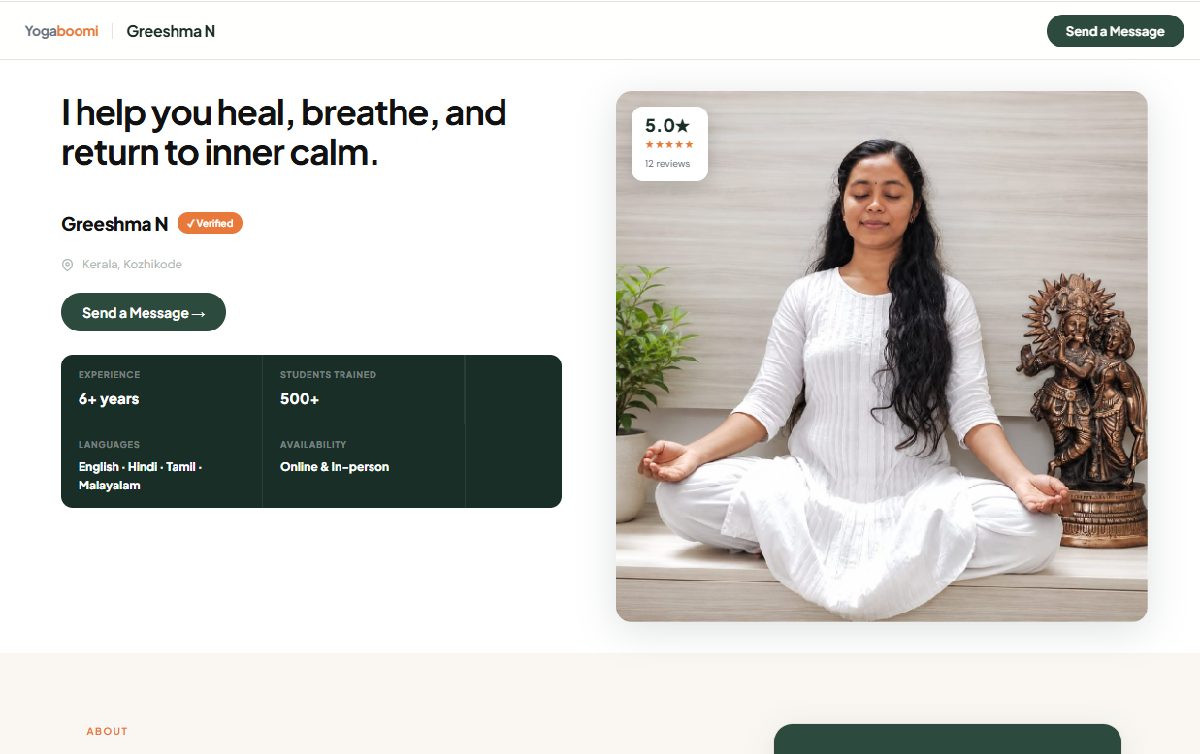
On Yogaboomi, this is the entire point of completing your profile properly rather than leaving it half done. Create your profile at yogaboomi.com/create and fill in everything: photo, bio, certifications, styles, teaching modes, schedule, fees, and languages. This becomes the one link you share with every enquiry, and it is indexed on Google from day one.
Khushboo Chatterjee's profile in Bengaluru is a good example of what a complete profile looks like. Styles listed clearly as Hatha, Vinyasa, and Restorative. Fees stated upfront at ₹1,800 per month. A short YouTube teaching clip. Six genuine reviews collected in her first few months. None of that happened by accident. It is what a filled out profile makes possible.
Also set up a free Google Business Profile if you teach from a fixed location, and keep a simple Instagram presence going. Three posts a week is enough to build credibility over time, you do not need to post daily.
Every Indian city has active WhatsApp and Facebook groups for residential societies and local wellness circles. A short, honest post describing what you teach, with a free trial offer for the first few respondents, tends to outperform paid ads for a brand new teacher. It arrives with community trust already attached, which a stranger's ad does not have.
Offering a free session at a local housing society, park, or community hall works the same way. Collect names and WhatsApp numbers on the spot, and follow up within 24 hours while the interest is still fresh.
Anamika Mishra, who has taught Prenatal and Therapeutic Yoga in Mumbai for a decade, keeps her batches capped at 5 students specifically so she can follow up with each one personally. That is not a scale limitation for her. It is the strategy. A student who gets a genuine message the next day asking how their body felt is far more likely to come back than one who does not hear from you until the next scheduled class.
Once someone confirms they are continuing, get their health history, yoga background, and goals on record before their first real class, rather than asking the same questions every session. A simple form, even a Google Form, works for this.
On Yogaboomi, this happens through your join form at yourname/join, which every confirmed student fills in automatically as part of signing up. You walk in already knowing how to teach them, instead of starting from a blank slate every time.
After your first 10 students, ask each one directly for a referral and a review. Referrals bring your next 10. Reviews make the 10 after that considerably easier to convert, because a new enquiry no longer has to take your word for it.
At 10 students this feels unnecessary. It is not. Keep a simple note, even a basic spreadsheet, of how each student found you and where they are in their journey with you: enquired, trialed, joined, or left. Glance at it once a month and you will start to see which channel is actually converting, instead of guessing six months from now when it is harder to remember what worked.
On Yogaboomi, your dashboard does this automatically. Students are separated into Pending, Active, and Past, so every enquiry is tracked and every record sits in one place without any extra spreadsheet to maintain.
Getting to 10 is mostly about removing friction and being findable in the two or three places people already look. What comes after, turning them into a full, steady schedule, is the next problem. It is a better one to have.