You have completed your TTC. You have been practicing for years. You know you want to teach. But turning that into an actual business, with paying students, a schedule, and a sustainable income, feels like a different thing entirely.
It does not have to be complicated. Here is where to start.
Forget the image of a large studio with a reception desk and multiple instructors. Most successful independent yoga teachers in India run a simple, lean operation:
A roster of 20 to 40 students across one or two batches. A mix of group classes and private sessions. Students who come through Google, referrals, and Instagram. A professional profile online that does the first round of trust-building before any conversation happens.
That is it. No studio rent. No staff. No complex infrastructure. Just you, your teaching, and a system that brings students in and keeps them.
Before you think about marketing or students, get clear on three things.
What you teach. Hatha, Vinyasa, Yin, Ashtanga, prenatal, therapeutic — pick your primary style and own it. Generalists exist but specialists grow faster because they are easier to find and easier to recommend.
Who you teach. Beginners, intermediates, working professionals, seniors, pregnant women, athletes — know your student. The clearer your picture of who you teach best, the easier everything else becomes.
How you teach. In-person, online, home visits, or a mix. Each has different economics and different student profiles. Start with what you are most comfortable with and expand from there.
This is the step most new teachers skip and later regret.
When a potential student hears about you, whether through a friend, Instagram, or Google, the first thing they do is look you up. If they find nothing, or a half-finished Instagram page, most of them move on without contacting you.
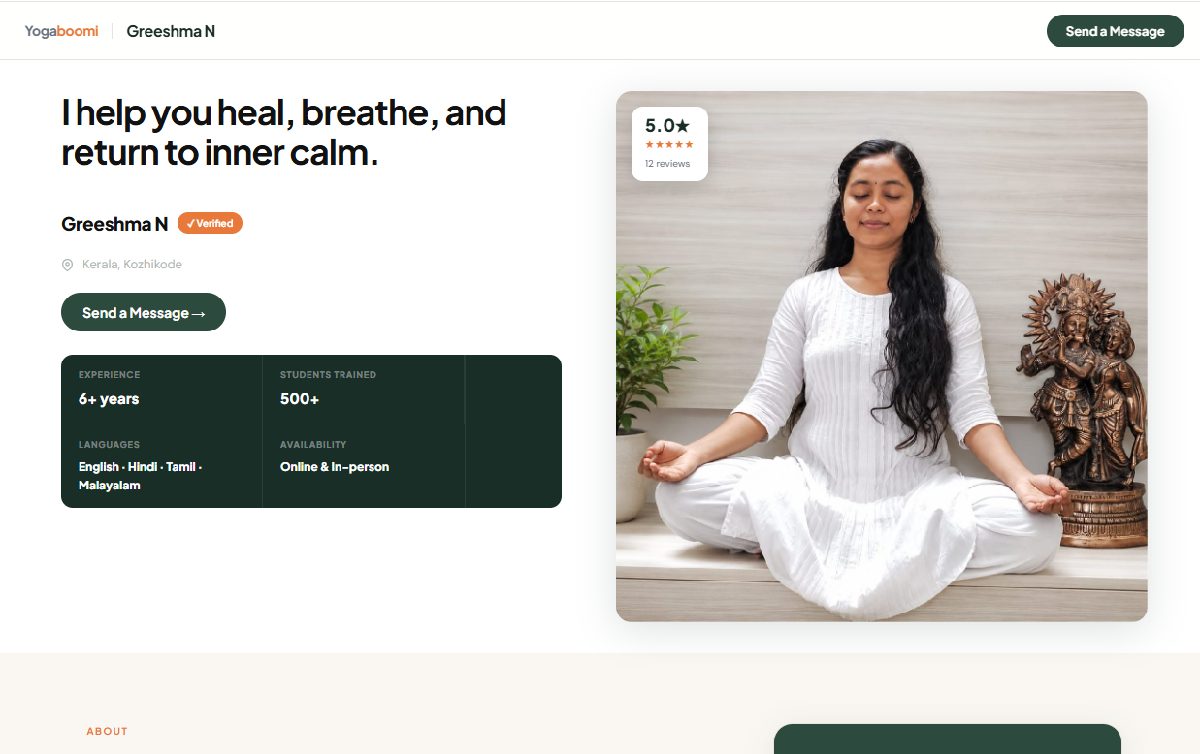
Before you do any outreach, create your Yogaboomi profile at yogaboomi.com/register. Fill it completely: your photo, bio, certifications, yoga styles, teaching modes, schedule, fees, and languages. This becomes the link you share with every potential student. It is indexed on Google from day one, which means students searching for yoga teachers in your city can find you organically over time.
See what a complete profile looks like at yogaboomi.com/swati-kumari.
Also set up a Google Business Profile if you have a fixed teaching location. And create a simple Instagram presence — three posts a week is enough to build credibility over time.
New teachers almost always underprice. It is understandable but it creates problems that are hard to fix later.
Underpricing attracts students who do not value the work. It makes fee increases awkward. And it sets an expectation in your local market that your teaching is entry-level.
A fair starting rate for a new teacher in a Tier 1 city is ₹1,500 to ₹2,000 per month for group classes. For private sessions, ₹500 to ₹700 per session. These are not premium rates but they are professional rates. They signal that you are serious.
Offer a free trial class to reduce uncertainty for new students. But your monthly fee should not be discounted to fill spots.
Your first students will come from three places: your personal network, community outreach, and online discovery.
Personal network: Go through your contacts and reach out individually to anyone who has mentioned stress, back pain, poor sleep, or wanting to be more active. Send them your Yogaboomi profile link and offer a free trial class. Target 20 people. If 3 say yes, you have started.
Community outreach: Offer a free yoga session at a local housing society, park, or community hall. Collect names and WhatsApp numbers. Follow up within 24 hours.
Online discovery: A complete Yogaboomi profile will start appearing in local Google searches within weeks of going live. This is passive discovery — students finding you without you having to reach out.
After your first 10 students, ask each one for a referral and a review. Referrals bring the next 10. Reviews make the following 10 easier to convert.
When you have 5 students, you can manage everything in your head. When you have 25, you cannot.
Start with a basic system early. Your Yogaboomi dashboard gives you a student pipeline: Pending students who have filled your join form, Active students currently enrolled, and Past students who have completed or left. Every enquiry is tracked. Every student record is in one place.
When a new student confirms they are joining, send them your Yogaboomi join form at yogaboomi.com/your-name/join. They fill in their health history, yoga background, and goals before their first class. You walk in already knowing how to teach them.
For payments, collect directly from students via UPI or bank transfer. Use Yogaboomi's receipt generation to issue auto-numbered, PDF payment receipts. It takes two minutes and makes you look professional.
A yoga business does not stabilise overnight. Give yourself a realistic timeline.
Month 1 to 2: Profile live, first batch started, 8 to 12 students enrolled. Month 3 to 4: First reviews collected, referrals starting to come in, second batch considered. Month 6: 20 to 25 students, stable income, profile appearing in local Google searches. Month 12: 30 to 40 students, mix of group and private clients, income between ₹60,000 and ₹1,00,000 per month depending on pricing and mix.
These are realistic numbers for a teacher who is consistent, professional, and actively building their presence. They are not guaranteed. But they are achievable.
It is not teaching quality. Most certified teachers are good enough to teach well.
It is visibility and trust. Students need to find you, and when they do, they need to immediately feel confident that you are the right teacher for them.
A complete Yogaboomi profile with verified reviews handles both. It makes you findable on Google and it builds trust before the first conversation.
Everything else in this guide matters. But this is where it starts.